Databricks CEO: AI Won't Kill SaaS, But Will Transform User Interfaces Into Invisible Infrastructure

Databricks has officially announced reaching a $5.4 billion revenue run-rate, demonstrating impressive 65% year-over-year growth. The company's AI products alone contributed over $1.4 billion to this figure, signaling a significant shift in enterprise technology consumption patterns.
Founder and CEO Ali Ghodsi addressed widespread concerns about AI's impact on the SaaS industry, emphasizing that artificial intelligence is actually driving increased usage rather than cannibalizing traditional software-as-a-service businesses. However, he acknowledges that AI will fundamentally transform how users interact with enterprise software.
Massive Funding Round Completed
The data analytics platform has successfully closed its previously announced $5 billion funding round at a $134 billion valuation, while also securing an additional $2 billion loan facility. This substantial capital injection positions the company as one of the most well-funded players in the enterprise AI space.
The AI-Native Interface Revolution
Databricks exemplifies the dual nature of modern enterprise platforms - maintaining its core identity as a cloud data warehouse provider while simultaneously evolving into an AI-first company. The company's LLM-powered user interface, Genie, represents a paradigm shift in how enterprises interact with data systems.
Genie enables users to query complex data warehouse information using natural language instead of specialized query languages or pre-programmed reports. This democratization of data access allows any employee to extract business insights without extensive technical training.
The Real Threat to Traditional SaaS
According to Ghodsi, the existential risk to SaaS companies isn't replacement of systems of record - the critical databases storing sales, customer support, and financial data. Migration costs and complexity make wholesale replacement impractical.
Instead, the fundamental threat lies in the commoditization of user interfaces. Traditional SaaS companies built competitive moats by requiring users to invest significant time mastering complex interfaces - creating armies of Salesforce specialists, ServiceNow experts, and SAP consultants.
Key implications of LLM-based interfaces:
• User interfaces become invisible infrastructure, similar to plumbing• Product-specific expertise becomes less valuable
• Natural language and API-based agent interactions replace traditional UIs
• Barriers to entry decrease for AI-native competitors
Agent-Optimized Infrastructure
Recognizing this shift, Databricks developed Lakebase, a database specifically engineered for AI agent workloads. Despite being available for only eight months, Lakebase has already generated twice the revenue that the company's data warehouse product achieved at the same stage of maturity.
Strategic Capital Position
Regarding future capital events, Ghodsi confirmed the company is not currently pursuing additional funding rounds or preparing for an initial public offering. He cited unfavorable market conditions and emphasized the strategic importance of maintaining substantial cash reserves as protection against potential market downturns, referencing the 2022 post-ZIRP correction. The current capitalization provides "many, many years of runway" for the organization.
🔔 Stay tuned and subscribe →
Related news



Read more on our blog

Try these AI tools
Tavily Search API: Optimize your AI with efficient, real-time search results. Reduce biases & inaccu...
Discover how GradientJ helps LLM teams build, manage, and optimize AI applications with ease.
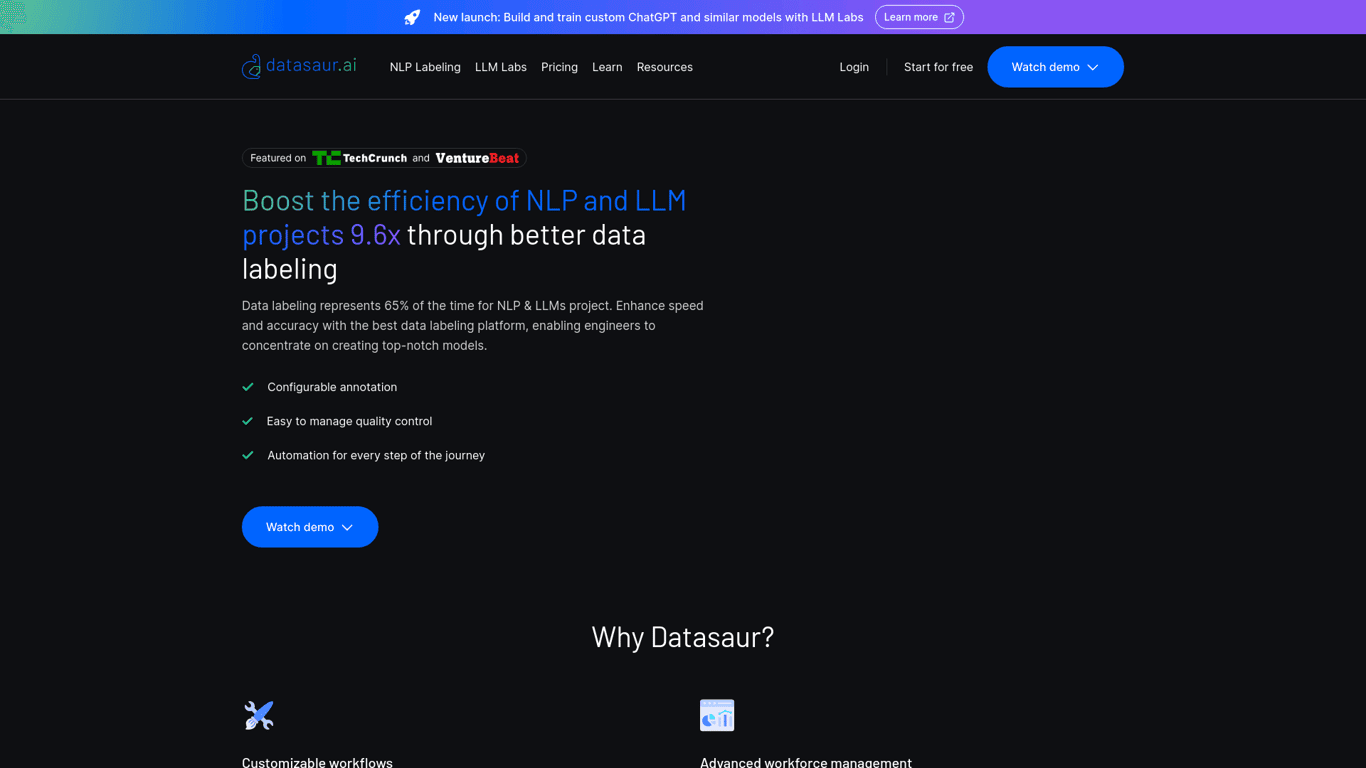
Explore Datasaur.ai's advanced NLP and LLM tools with customized features for various industries. Im...