Elon Musk Unveils Lunar Manufacturing Vision for Deep Space AI Infrastructure Following xAI-SpaceX Merger
Following a significant corporate restructuring that resulted in the departure of several senior executives, xAI CEO Elon Musk has announced an ambitious new strategic direction for the merged xAI-SpaceX entity. The vision centers on establishing lunar-based manufacturing capabilities for deep space artificial intelligence infrastructure.
Recruitment Strategy Shifts to Lunar Manufacturing
In a public statement, Musk invited prospective engineers to join xAI if the concept of "mass drivers on the Moon" resonates with their professional interests. This recruitment approach follows the company's merger with SpaceX and precedes an anticipated initial public offering. The strategic pivot represents a departure from conventional AI development narratives focused solely on achieving artificial general intelligence (AGI) or disrupting traditional software markets.
From Orbital Data Centers to Lunar Infrastructure
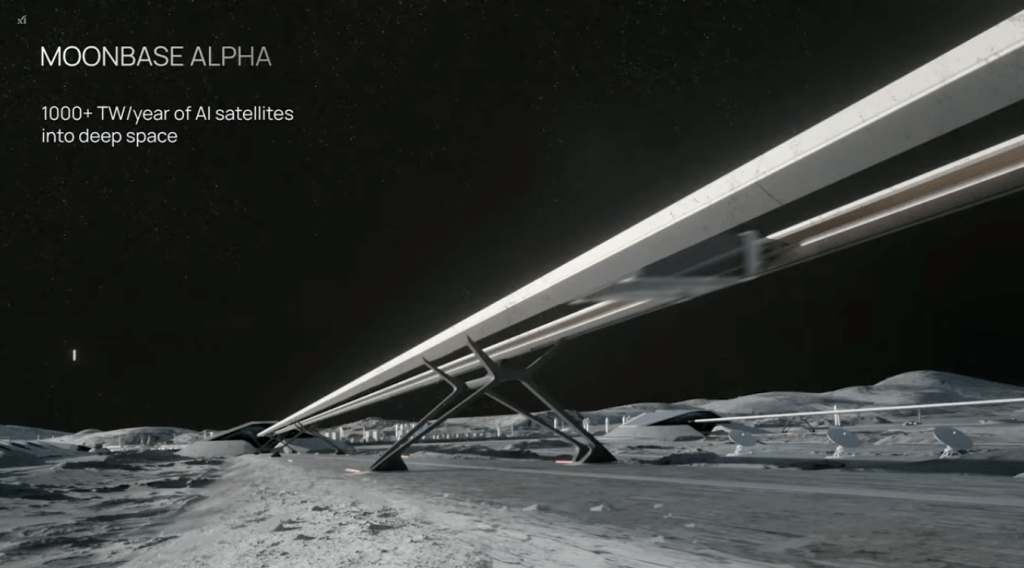
Building upon previously announced plans for orbital AI data centers, Musk outlined a more ambitious roadmap during an all-hands meeting. The proposal extends beyond Earth-orbiting computational facilities to establish deep space AI infrastructure. The key innovation involves constructing a lunar city dedicated to manufacturing space-based computing systems and deploying them throughout the solar system using electromagnetic mass driver technology—essentially large-scale maglev launch systems.
"What if you want to go beyond a mere terawatt per year?" Musk posed to employees. "To do that, you have to go to the moon...I really want to see a mass driver on the moon that is shooting AI satellites into deep space."
Kardashev Scale and Energy Harvesting Ambitions
The lunar base concept aligns with the Kardashev Scale framework—a theoretical classification system for civilizations based on energy consumption capacity, originally proposed by Soviet astronomer Nikolai Kardashev in the 1960s. According to Musk's presentation, lunar manufacturing infrastructure could enable harnessing "maybe even a few percent of the sun's energy" for AI model training and operation.
"It's difficult to imagine what an intelligence of that scale would think about," Musk stated, "but it's going to be incredibly exciting to see it happen."
Strategic Narrative Evolution
This announcement represents a significant pivot from SpaceX's long-standing Mars colonization narrative. The lunar manufacturing vision emerges as SpaceX has publicly scaled back its Martian ambitions, which faced substantial technical and financial challenges. Previous plans to repurpose Dragon spacecraft for Mars landing operations were discontinued in 2017 due to cost considerations.
The shift reflects practical business realities: SpaceX's Starship development has increasingly focused on revenue-generating contracts, including:
• Satellite deployment for the Starlink communications network
• $4 billion in NASA contracts for lunar astronaut landing missions
Technical Feasibility and Timeline Considerations
Industry experts suggest that orbital data center deployment could become viable in the 2030s. However, lunar-scale semiconductor manufacturing would require several prerequisite technological breakthroughs:
1. Dramatically reduced space launch costs
2. Successful demonstration of precision component manufacturing in extraterrestrial environments
3. Establishment of raw material supply chains to lunar facilities
4. Development of self-sustaining lunar habitat infrastructure
Current research initiatives are exploring in-space semiconductor fabrication, though mass production of advanced computing systems on the Moon remains a long-term objective requiring substantial technological advancement.
Corporate Strategy and Market Positioning
The ambitious vision serves multiple strategic purposes: differentiating xAI's value proposition beyond conventional large language model development, providing a compelling narrative for the anticipated IPO, and offering engineering talent a distinctive mission statement that transcends incremental AI research.
As one departing executive noted upon exit: "All AI labs are building the exact same thing, and it's boring." The lunar manufacturing concept, regardless of near-term feasibility, positions the merged entity with a unique strategic narrative in an increasingly crowded AI development landscape.
🔔 Stay tuned and subscribe →
Related news


Try these AI tools
Elon Musk discusses the future of a civilization on Mars, highlighting reusable rockets and governan...