Ex-Google Engineers Launch InfiniMind to Transform Enterprise Video Dark Data into Actionable Intelligence

Enterprise organizations are generating unprecedented volumes of video content, from decades of broadcast archives to extensive surveillance footage and production materials. However, the vast majority of this data remains dormant on storage infrastructure—unwatched, unanalyzed, and unutilized. This phenomenon, known as dark data, represents a significant untapped resource that organizations collect automatically but rarely leverage for strategic insights.
To address this challenge, Aza Kai (CEO) and Hiraku Yanagita (COO), two former Google engineers who collaborated for nearly a decade at Google Japan, founded InfiniMind, a Tokyo-based startup developing infrastructure to convert petabytes of unstructured video and audio content into structured, queryable business intelligence.
"My co-founder, who spent a decade leading brand and data solutions at Google Japan, and I identified this inflection point while still at Google," Kai explained. "By 2024, the technology had matured sufficiently, and market demand had crystallized to the point where we felt compelled to build the solution ourselves."
Kai, who previously worked across cloud infrastructure, machine learning systems, advertising platforms, and video recommendation algorithms at Google Japan before leading data science teams, noted that existing solutions forced significant tradeoffs. Legacy approaches could perform object labeling on individual frames but lacked the capability to track narratives, understand causality, or respond to complex queries about video content. For clients managing decades of broadcast archives and petabytes of footage, even fundamental questions about their content library remained unanswered.
The technological breakthrough came from advances in vision-language models between 2021 and 2023, enabling video AI to progress beyond simple object tagging. While declining GPU costs and annual performance improvements of approximately 15-20% over the past decade contributed to feasibility, the critical factor was capability enhancement—until recently, models simply lacked the necessary functionality to address enterprise requirements.
InfiniMind recently closed a $5.8 million seed funding round, led by UTEC with participation from CX2, Headline Asia, Chiba Dojo, and an AI researcher at a16z Scout. The company is relocating its headquarters to the United States while maintaining operational presence in Japan.
Japan provided an ideal testing environment: robust hardware infrastructure, exceptional engineering talent, and a supportive startup ecosystem enabled the team to refine its technology with demanding enterprise clients before pursuing global expansion.
The company's initial product, TV Pulse, launched in Japan in April 2025. This AI-powered platform analyzes television content in real-time, enabling media and retail organizations to:
• Track product exposure and placement
• Monitor brand presence and visibility
• Analyze customer sentiment
• Measure PR impact and effectiveness
Following pilot programs with major broadcasters and agencies, TV Pulse has secured paying customers, including wholesalers and media companies.
InfiniMind is now prepared for international market entry. Its flagship enterprise product, DeepFrame—a long-form video intelligence platform capable of processing 200 hours of footage to identify specific scenes, speakers, or events—is scheduled for beta release in March, with full commercial launch planned for April 2026.
The video analysis market remains highly fragmented. While companies such as TwelveLabs provide general-purpose video understanding APIs targeting consumers, prosumers, and enterprises broadly, InfiniMind focuses specifically on enterprise use cases, including monitoring, safety, security, and deep content analysis.
"Our solution requires no code; clients provide their data, and our system processes it to deliver actionable insights," Kai stated. "We integrate audio, sound, and speech understanding alongside visual analysis. Our system handles unlimited video length, and cost efficiency represents a major differentiator. Most existing solutions prioritize accuracy or specific use cases but fail to address cost challenges."
The seed capital will support continued development of the DeepFrame model, expansion of engineering infrastructure, team growth, and customer acquisition across Japan and the United States.
"This represents an exciting domain—one potential pathway toward AGI," Kai concluded. "Understanding general video intelligence means understanding reality itself. While industrial applications are important, our ultimate objective is to push technological boundaries to better understand reality and enable humans to make superior decisions."
Sources:
🔔 Stay tuned and subscribe →
Related news


Try these AI tools
DataRobot unifies predictive and generative AI to build, deploy, and govern secure, enterprise-ready...
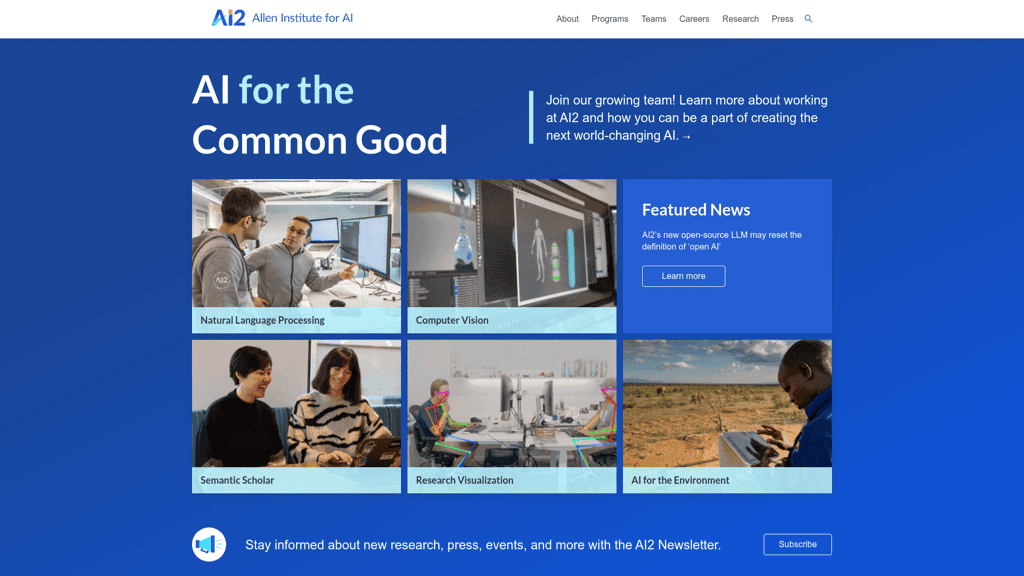
AI2 conducts high-impact AI research and engineering with a focus on collaboration, diversity, and s...
Discover how Athenic AI provides rapid data insights with automatically generated SQL for various in...