Press for navigation
Swipe for navigation
PandasAI
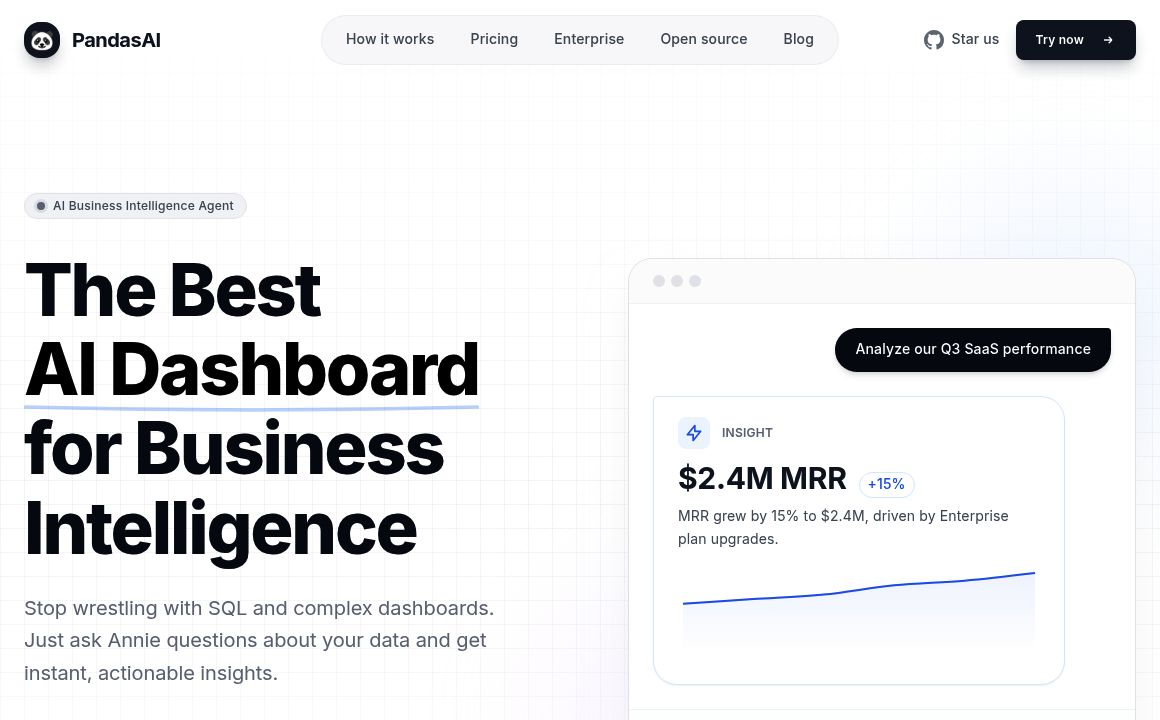
PandasAI merges AI with Pandas, enabling easy data analysis through natural language.
Python Libraries
Updated 2 hours ago
PandasAI's Top Features
Natural Language Querying
Data Summarization
Data Visualization
Data Cleaning
Feature Generation
Machine Learning Integration
Automated Insights
Multi-DataFrame Operations
Customizable Interface
Open Source and Extensible
Frequently asked questions about PandasAI
PandasAI integrates the Pandas library with AI models to enable data analysis through natural language, transforming queries into executable Python code using AI like OpenAI's GPT models.
It's user-friendly, allowing interactions with data via natural language prompts, though complex analyses may need clearer prompts.
Key capabilities include data cleaning, manipulation, and visualization, as well as handling multiple dataframes and performing natural language querying.
Limitations include challenges with complex queries, memory constraints with large datasets, dependency on input clarity, and API costs.
Yes, it integrates with visualization libraries like Matplotlib and Seaborn and supports various data sources.
It supports LLMs like OpenAI's GPT models, Google's PaLM, and others, with evolving support based on user needs.
Yes, it's open-source, but users incur costs for LLM APIs necessary for its core functions.
Pandas focuses on data manipulation through coding, while PandasAI offers natural language interaction for accessible data analysis.
It requires Python 3.8 or higher, the Pandas library, and an API key for LLMs.
Yes, it offers enterprise solutions suitable for large-scale implementations.
PandasAI's pricing
Free
Free/
- Open-source access
- Compatibility with any large language model
- UI starter kit via Docker
Plus
N/A/
- Team UI
- Priority ticket support
- Access to BambooLLM and Semantic Agent
Enterprise
custom/
- End-to-end AI solutions
- No-code data cleaning
- Future-proof integration
Prev Project